top of page

Black Poplar (Populus nigra) - British Rarest Forestry Trees
Native Black Poplar
Recovery Project
About the project
Black Poplar Populus nigra ssp. betulifolia is a very rare tree today with little planting having taken place for the last 150 years. It used to be an important component of river valleys in Britain and northern Europe and Trees for Dorset are aiming to reintroduce large numbers back into the Dorset countryside and beyond.


Why does it need saving?
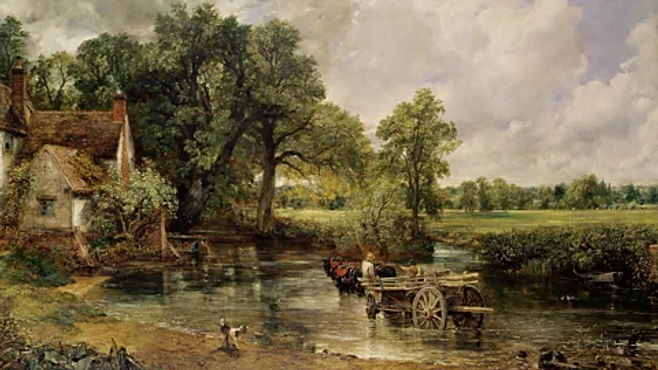
There are only 7,000 mature trees left in the country and of these only about 500 are female. It was an icon of the British treescape and features in Constable’s painting The Haywain.
Many species rely on poplar to live breed and thrive and as it is a tree that favours damp conditions, it will help clean up our river systems and combat climate change as part of wetland restoration schemes.
(Picture of The Haywain by Constable)
Why is it under threat?
It is a tree of wetlands and river catchments, and the wood was used to make cartwheels and floor-boards due its resistance to burning.
They are under threat for several reasons.
-
To thrive naturally the seed needs to fall onto damp ground when it seeds in June and due to the excessive draining of our landscape this feature is now rare.
-
Man no longer uses the wood for cartwheels and floorboards preferring to plant non-native species of poplar which grow straighter.
-
It needs male and female trees growing near each other to produce viable seeds.
-
It was generally propagated by cuttings normally from males as they don’t produce the fluffy cotton seeds.
All this means there are now only about 7000 native black poplar trees left in the UK of which most are males. There are several groups around the UK attempting to reverse this decline and build up sustainable populations for future generations and of course for the wider benefits to wildlife and the faunal species they support.
How do I recognise a true native Black Poplar?
Hybrid poplar are plentiful in the British landscape. The very rare native forms are quite different and once you have seen a truly native tree the differences become apparent.
The main features to look out for
-
The trunks of native forms often lean away from the prevailing wind
-
Burring on the trunk Leaning Trunk and burring on the trunk.
-
Branches come out of the main trunk close to horizontal and quite quickly start to angle downwards before rising up again towards the tips of the branches
-
The leaves of the native forms are generally smaller and have a distinct arrow shaped tip to the leaf
-
As the leaves emerge the petioles (leaf stems) are covered in fine hairs
-
Towards middle and late summer galls that put a distinct twist on the petiole appear. These are caused by an aphid but they only appear on the native form.
How do I tell a male from female tree?


Black polar flower in March and early April.
The male trees have red catkins

and the females have green catkins

Later on the females produce masses of white cotton like seeds
What to do if I think you have found one?
Please Get in touch by emailing some photos of the leaves, trunk and whole tree and we will be happy to advise as to whether it is or isn’t a native form. If we think it is a native form we will send one of our experts to take a look and gather some samples for genetic testing.
Genetic testing
There are just over 200 known forms of native black poplar. Having trees tested to find out which clone they are provides important information.
Firstly it will definitively prove if the sample is a genuinely native clone.
Secondly, if it is the same as other trees found elsewhere it provides clues as to how the trees were spread around the countryside and
Finally, it could be a unique and as yet unregistered clone which would be very exciting.
To date Trees for Dorset have tested about 40 trees now and discovered 14 different clones in the county.
So how are Trees for Dorset going to restore
the population of Native Black Poplar?
Here’s the plan
-
Search for and discover veteran / established BPs in Dorset.
-
Having found them we are having them clone tested to find out which clone they are.
-
We are then taking cuttings from these to produce young plants
-
We are also trading known clone plants with other groups to improve the genetic diversity we hold and again taking cuttings of these.
-
We are now establishing a clone bank of mother plants from which we can create a sustainable supply of young plants to go back into the environment. (Currently we have about 14 clones and we are hoping to double this by 2027 by swapping material with other groups.)
-
Then we are working with landowners and organisations such as the National Trust, Dorset Wildlife Trust, RSPB and water companies to identify planting sites to get them back where they belong… in river catchments.
-
With the sites identified trees will be supplied in packs of assorted clones say 2 different males with 4 different female trees and that the landowners and partner organisations will plant these in groups so that there is further genetic mixing leading to new clones in the future from the seeds they produce.
-
Finally the planting positions with clone numbers will be recorded for posterity
How you can help
Keep an eye out in your local area and as you are travelling around for veteran black poplar trees
Help us produce trees in the nurseries
If you have an acre or more of wet land, provide a home for a group of Black Poplar
Please get in touch we would love to hear from you
info@treesfordorset.co.uk



bottom of page